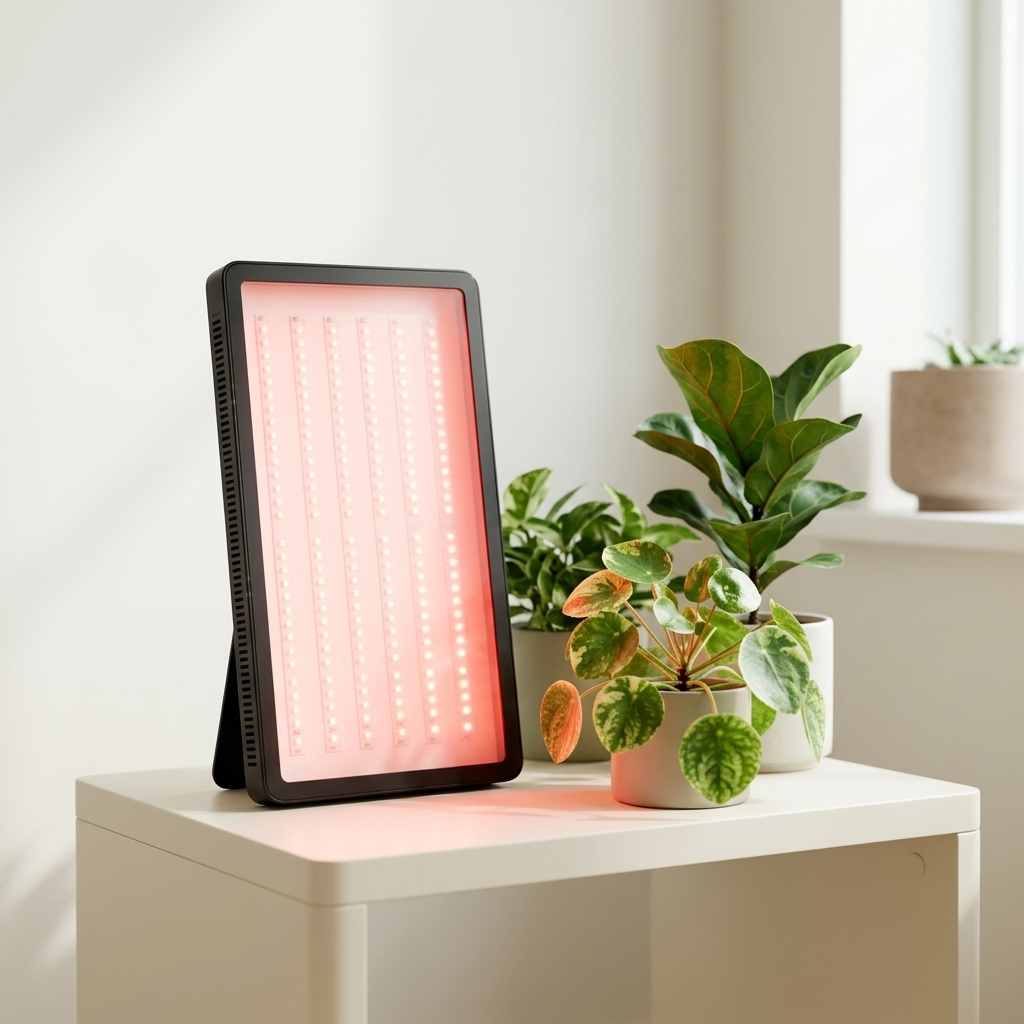
Red light panels are in every biohacker’s setup now: shine it on yourself and supposedly you’ll look younger, torch fat, spike your testosterone, and “charge your cells.” Here’s what makes red light interesting — for once, it isn’t pure pseudoscience. The mechanism is real. The trouble is that the marketing sprinted about ten miles ahead of the evidence. Let’s draw the line.
Give it its due: the mechanism is real
Credit where it’s earned. Specific wavelengths — red around 630–660 nm and near-infrared around 810–850 nm — are absorbed by the mitochondria in your cells and give energy production (ATP) a modest nudge. That’s not magic and it isn’t marketing; the mechanism is well documented. The only real question is where that translates into a genuine effect, and where the science stops and the price tag begins.
What red light therapy actually works for
The rule is simple: it works where the light physically reaches — your skin and what sits just beneath it.
Skin
A controlled trial of 136 volunteers — with a control group and blinded evaluation — found that red and near-infrared light measurably reduced wrinkles, improved skin texture, and increased intradermal collagen density. And these were measured with instruments and ultrasound, not “looks better in the mirror.”
Hair
A meta-analysis of double-blind, sham-controlled trials found that low-level laser/light therapy significantly increases hair density in pattern hair loss — in both men and women. Not a miracle mane overnight, but a real, measured effect.
And a few more
There’s also decent evidence for wound healing, acne, and localized pain and muscle recovery. Same logic every time: it works where the light can actually reach.
Where the marketing drives off a cliff
Anything sold as a whole-body effect is standing on very thin ice:
- Testosterone. “Shine it on your testicles and your T climbs” is a popular influencer line with essentially no human evidence behind it.
- Fat loss and “body contouring.” The data is weak, and any effect is cosmetic and temporary at best.
- “Charges every cell,” “detox,” “longevity.” Here’s the fact that sinks these promises: red and near-infrared light penetrate only a few millimeters to roughly a centimeter of tissue. It reaches your skin and hair follicles — it does not “charge” your internal organs through a panel in the corner of the room.
Even the real benefits come with fine print
And where it does work, there’s a catch the ads skip. Dose isn’t a “more is better” situation — light has a biphasic response: too little does nothing, too much can cancel the benefit out. On top of that, cheap panels vary wildly in wavelength and power, so a good chunk of what’s sold is either underpowered or used wrong. Real results take a proper device, the right dose, and consistency — not a stare-at-it-once-when-you-feel-like-it approach.
The bottom line
Red light therapy is neither a scam nor a miracle. For skin and hair, it’s a legitimate, evidence-backed tool — if you buy a decent device and actually use it. For testosterone, fat loss, and “whole-body cellular energy,” you’re buying an expensive placebo shaped like a lamp. Simple rule: point it at your face and scalp, not at your whole life.
Red light is a perfect example of the real problem with biohacking gear: a tool with a narrow, genuine use, buried under whole-body promises — plus a dozen small decisions (device, wavelength, dose, timing) that decide whether you get results or just a warm glow. That’s exactly what I break down inside Biohack Academy: which tools are actually worth it, the protocols that work, and what to skip — with the science behind each call. If you’d rather get it right than guess, that’s where to start.
Not medical advice. Don’t look directly into the light, and don’t expect a lamp to treat disease — this is a cosmetic and recovery tool, not medicine.